A Complete Guide to the Restricted Radiotelephone Operator Permit (RR) for Private and Commercial Pilots
If you fly only within the United States using standard VHF aircraft radios, you generally do not need an FCC radio operator permit. But once you start flying internationally, communicating with foreign stations, or operating equipment such as HF radio outside normal domestic VHF-only operations, the FCC rules become relevant fast. The permit most pilots are looking for is the Restricted Radiotelephone Operator Permit, usually shortened to RR or RROP. The FCC says at least one person on each aircraft flying internationally must hold this permit.
This is where many pilots get tripped up: they search “FCC radio license for pilots,” land on scattered forum answers, and come away with half the story. The real answer is that there are two separate FCC concepts you need to understand:
- the operator permit for the person, and
- the radio station license for the aircraft.
This guide is built to fix that. It is written for FAA-certificated private pilots, commercial pilots, flight instructors, and owners/operators who want the correct process without wasting time in the FCC maze.
The Short Answer
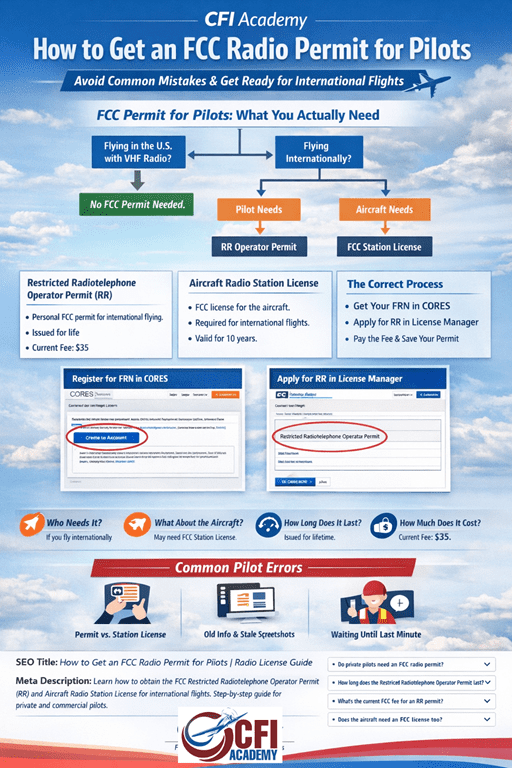
If you are a U.S. pilot flying only domestically on standard VHF radios, you usually do not need the FCC Restricted Radiotelephone Operator Permit. But if you are flying internationally, the FCC says at least one person on the aircraft must hold an RR permit, and your aircraft may also need an FCC Aircraft Radio Station License. The RR permit is issued for the holder’s lifetime, and the current FCC application fee for Restricted Radio Operator filings is listed at $35.
If you’re working toward a commercial pilot or flight instructor certificate, this FCC permit is just one small administrative step in a much larger pilot training path.
What the FCC Restricted Radiotelephone Operator Permit Actually Is
The Restricted Radiotelephone Operator Permit (RR) is an FCC-issued commercial radio operator credential. The FCC describes RR holders as being authorized to operate most aircraft and aeronautical ground stations, and the FCC’s commercial operator materials state that at least one person holding an RR permit is required aboard aviation stations when making international flights or communications.
For pilots, that means this permit is not some obscure airline-only document. It matters most when your flying goes beyond normal domestic U.S. operations. That includes pilots crossing borders into places such as Canada, Mexico, the Bahamas, or the Caribbean, and it becomes even more relevant if your operation includes radios or communications equipment beyond basic domestic VHF use.
Do student pilots need an FCC radio operator permit? Who does?
You usually do not need the permit if:
- you are flying only inside the United States, and
- you are using normal VHF aircraft radio equipment in domestic operations.
You likely do need it if:
- you will be making international flights, or
- you will be communicating internationally, or
- your operation involves frequencies under 30 MHz, such as HF radio scenarios covered by FCC commercial operator guidance.
That is the practical dividing line. Domestic U.S. VHF-only pilot? Usually no permit needed. International operator? Different story.
Most pilots first encounter this requirement during commercial or instructor training. If you’re not sure where you are in the process, this guide explains the full sequence.

The Other Thing Pilots Miss: The Aircraft May Need Its Own FCC License
This is the part a lot of websites leave out.
The Restricted Radiotelephone Operator Permit is for the person. It is not the same thing as the Aircraft Radio Station License, which is for the aircraft. The FCC’s aircraft licensing materials say you must obtain an FCC Aircraft Radio Station License if you make international flights or communicate with foreign stations. The FCC’s current Aircraft Stations page also shows that aircraft station licenses are issued for 10 years.
So if you are preparing for international flying, your checklist should not stop at “get my FCC permit.” It should be:
- Do I, as a pilot/operator, need the RR permit?
- Does my aircraft also need an Aircraft Radio Station License?
For many GA owners planning cross-border flying, the answer to both is yes.
How Long the Permit Lasts
This is the good news.
The FCC says the Restricted Radiotelephone Operator Permit is issued for the holder’s lifetime. That means once you get it, you generally do not keep renewing it every few years like a medical or flight review.
That is one reason this is worth doing correctly the first time.
What It Costs
As of the FCC’s current application fee schedule, Restricted Radio Operator (RR) filings are listed at $35. FCC fee schedules can change, so treat that as current at the time of writing, not a forever number.
That is another reason bad advice online is expensive. People waste more than $35 in time alone chasing stale instructions.
The Correct Modern Process
The FCC licensing process now revolves around CORES for registration and FRN management, and ULS / License Manager for the actual licensing workflow. The FCC’s own licensing pages say you first register and manage your FCC Registration Number (FRN) in CORES, and then use FCC licensing systems for the filing itself. The FCC’s ULS guidance says new-license applications are filed online and, if fees are due, they can be paid online after submission.
In plain English, the process is:
- Create or confirm your FCC Registration Number (FRN) in CORES.
- Log in to the FCC’s licensing system using that FRN.
- Apply for the Restricted Radiotelephone Operator Permit (service code RR).
- Complete the certification steps and pay the application fee if due.
- After grant, save copies of your permit and records. The operator permit is lifetime; the aircraft station license, if needed, is a separate filing with its own term
Step-by-Step: How to Get the FCC Restricted Radiotelephone Operator Permit
Step 1: Get an FRN in FCC CORES
Before you can file anything meaningful with the FCC, you need an FCC Registration Number (FRN). The FCC’s CORES system is where you register and manage that number. FCC licensing guidance states that the FRN uniquely identifies you in FCC transactions.
What to do
- Go to the FCC CORES registration system.
- Create a new FRN if you do not already have one.
- Save your username, FRN, password, and recovery information somewhere secure.
Step 2: Log In to FCC License Manager / ULS
Once you have your FRN, move into the FCC licensing side. The FCC’s licensing and ULS guidance says to log in with your FRN and password to apply for a new license online.
What to do
- Log in to the FCC licensing system using your FRN.
- Choose the option to apply for a new license.
- Select the appropriate radio service / filing path for the Restricted Radiotelephone Operator Permit (RR).
Step 3: Choose the Correct License Type
This is where people often click the wrong thing and then wonder why the application flow makes no sense.
You are looking for Restricted Radiotelephone Operator Permit (RR). FCC commercial radio operator materials specifically identify RR as the service code for this permit.
If you are applying for the pilot’s operator permit, you are not applying for the aircraft station license in this step. That is a separate filing concept.
Step 4: Complete the Questions Carefully
Older blog posts often tell people to “answer no to all three questions” and move on. That is too sloppy for a serious guide.
The smarter advice is this: read the application questions exactly as displayed at the time you file, because FCC interface language and sequencing can change. The FCC’s filing systems and fee-exemption pages are the authority, not screenshots frozen in time from old articles.
What does stay constant is that you are applying for an individual operator permit, not a school, not a station authorization, and not a pilot certificate. Read every certification block as if it matters, because it does.
Step 5: Pay the Fee
If your filing is not fee-exempt, the FCC says fees due can be paid online after submission, and the current published fee schedule lists Restricted Radio Operator (RR) at $35.
Step 6: Download and Save the Permit
The FCC says the Restricted Radiotelephone Operator Permit is issued for the holder’s lifetime. Once granted, keep a digital copy in your records and save a PDF backup locally.
For practical use, I would keep:
- a PDF in your cloud storage,
- a copy in your flight-documents folder,
- and a backup with your passport/international documents set.
That last part is not a regulation. It is just smart international-operating hygiene.
Once you have your FCC permit, the next step is continuing your training toward advanced certificates like Commercial Pilot and CFI.

Do You Also Need the Aircraft Radio Station License?
Yes, maybe — and many pilots do
The FCC’s aircraft licensing materials say an aircraft radio station license is required if you make international flights or communicate with foreign stations. The FCC’s Aircraft Stations page also shows that the station license term is 10 years and that a copy must be kept with the aircraft station records.
That means your pilot-side permit and aircraft-side license are not interchangeable:
- RR permit = for the operator/person.
- Aircraft Station License = for the aircraft/radio station.
If you own or operate the aircraft and plan international flights, do not stop after the RR filing. Check the aircraft station licensing side too.
A Better Real-World Rule for Pilots
A lot of pilots ask, “Do I need this for Canada?” or “Do I need this for Mexico?” That is understandable, but it is the wrong way to think about it.
The better rule is:
If your operation is international, assume you need to verify both the pilot/operator permit and the aircraft station license, then confirm against current FCC and destination-country requirements.
That is the serious answer, and it is the only answer that scales beyond one border crossing.
Why This Matters More Than It Looks
International flying is not just “domestic flying plus a passport.” The FAA’s international flying guidance reminds pilots that international operations bring additional requirements involving equipment, customs, procedures, radios, HF in some areas, and foreign-country rules. The FAA specifically notes VHF is required when departing or entering the U.S., HF is necessary in airspace out of VHF range, and many foreign operations involve additional paperwork and operating requirements.
That is why this FCC permit question matters. It is one piece of a broader “international readiness” puzzle. And if you overlook small documentary items early, you are the pilot who ends up scrambling later.
At CFI Academy, we see many applicants who reach this step without fully understanding the larger training strategy. The difference between finishing training efficiently vs wasting time and money usually comes down to having the right roadmap.
Common Mistakes Pilots Make
1) Confusing the permit with the aircraft station license
These are separate. One is for the person. One is for the aircraft.
2) Following stale screenshots from old blog posts
FCC systems change. Use old screenshots only as orientation, never as authority. Current FCC live pages and fee schedules control.
3) Assuming “I’m just GA, so this doesn’t apply to me”
The FCC’s own materials do not limit the permit concept to airlines. They tie it to the type of operation, especially international flights and communications.
4) Waiting until the week of an international trip
That is amateur-hour planning. If you know international flying is on your horizon, get this done early.
CFI Academy Perspective
The reason this page gets so much traffic is obvious: the FCC process is easy once you understand it, but annoyingly unclear when you do not. The old low-quality advice on this topic usually falls into two buckets:
- oversimplified “click here, click there” posts that ignore the aircraft license issue, or
- legalistic FCC text dumps that are technically accurate but practically useless.
Neither is good enough.
If you are training for a professional pilot path, this is the standard you should apply to everything: don’t just ask whether a document exists. Ask what role it plays, when it applies, and what adjacent requirement people usually miss. That is how serious pilots stay ahead of paperwork instead of getting ambushed by it.
Usually no, if the operation is domestic and limited to standard VHF aircraft radio use within the United States.
The FCC says at least one person on each aircraft flying internationally must have a Restricted Radiotelephone Operator Permit.
No. The operator permit is for the person. The aircraft station license is for the aircraft. Many pilots need to check both for international operations.
he FCC says it is issued for the holder’s lifetime.
The FCC’s current application fee schedule lists Restricted Radio Operator filings at $35. Always verify the live fee before filing.
Yes. The FCC’s CORES system is where you register and manage your FRN before filing.
Often yes. FCC aircraft licensing materials say you must obtain an aircraft radio station license if you make international flights or communicate with foreign stations.
Bottom Line
If your flying is strictly domestic U.S. VHF-only flying, this FCC permit is usually irrelevant. But if you are flying internationally, it is absolutely worth understanding the difference between the Restricted Radiotelephone Operator Permit and the Aircraft Radio Station License. The FCC permit is for you. The aircraft station license is for the airplane. The permit is lifetime. The aircraft license is separate. And the current FCC filing process starts with your FRN in CORES.
What Comes After the FCC Permit?
The FCC permit is one of the smallest steps in becoming a professional pilot or flight instructor. What matters is what you do next.
Flight Instructor Training Resources
This article is part of the broader instructional resources published by CFI Academy for pilots pursuing certification as flight instructors.